Tan Thai’s life could be a novel or a movie. A Distinguished Member of the Technical Staff at Sandia National Laboratories in Albuquerque, Tan was a middle school teacher in Vietnam twenty-five years ago when Saigon fell to the communists.
The life Tan enjoyed while growing up in Vietnam changed drastically after that. His father, a businessman, lost everything. His younger brother, Loc, was drafted by the communists to carry ammunition. Tan could not see past a bleak future.
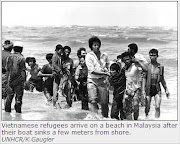
He says the strength and love of his mother motivated him and his older sister, Mai, to escape Vietnam. “Don’t cry,” she said, as they left. They were captured on their first attempt but were successful on their next attempt.“Successful” meant they arrived in a crowded boat at Pulau Bidong, asmall island off the east coast of Malaysia, after three days and nights at sea. Their journey included being robbed on three separate occasions by Thai sea pirates. The pirates threatened their lives and terrorized them. “Only by God’s grace did they let us go,” says Tan. The small wooden fishing boat was overcrowded with about 50 people of all ages. “People vomited
all around me, the odor was horrific,” says Tan. “My sister and I had some water but no food.” Their arrival in Pulau Bidong was also traumatic, but a happy surprise
awaited them. As Tan and Mai sat on the dock, their brother Loc appeared. They had not heard from Loc in a very long time, but he also had escaped. Loc told them he had gone every day to the only dock on the island in hope of seeing family members.
There were 6,000 refugees in Pulau Bidong when they arrived.They built their own houses from abandoned materials like plastic sugar bags and wood from trees harvested
from the island’s hills. Beds were constructed out of tree bark, later “upgraded” with wooden planks. “Our stay at Pulau Bidong lasted about six months,” Tan says. “Some refugees had to wait for five or six years if they didn’t have relatives or friends in any sponsoring countries. We were fortunate. My sister’s
husband had escaped in 1975 and lived in Dallas, so it took us only half a year of waiting in Bidong.” However, because of Loc’s health problem, Tan and Mai ended up
waiting another three months in a transit camp. As for Loc, it took him another six months to reach the U.S. Initially, they all lived together in Texas. About a year and a half after arriving in Dallas, Tan moved to
Arkansas where an aunt and uncle offered him a place to stay while attending the University of Arkansas. Tan’s degrees in electrical engineering brought him to Sandia
Labs in 1987 by way of AT&T. Today at Sandia, Tan does research and development for
computer security applications. He was promoted to Distinguished Member of Technical Staff in 2001. Tan and his wife Lan, a Vietnamese interpreter at the University of New Mexico, have three children, Hannah, Nathan, and Stephen. Tan also serves as a
biovocational pastor at a Vietnamese church. His nights and most of the weekend are filled with church work and family activities. His brother Loc works for
Boeing and sister Mai works for an electronics firm. They both live in Texas. Their mother died before her paperwork to enter the U.S. was completed. Tan became
a U.S. citizen in 1986 in Arkansas. Although he is glad that his children did not have to experience his quest for freedom, he hopes that they value what they have
in the U.S. “To me, mine is a typical American story,” says Tan.
http://nnsa.energy.gov/news/documents/2003SepOct_NNSA_News.pdf
Wednesday, November 5, 2008

Tuesday, November 4, 2008
Bidong Story - 1
This morning some one told me that Malaysia isn’t an Island.
Then I did a Google search on Pula Bidong which turns up Binh Danh’s project. I didn’t even spell it correctly but Google was smart to suggest the correct spelling. I’m excited. It triggered some memories. I remember lying on the island during Christmas time. The PA system broadcast Christmas music. We got better treats from the Uni-chief organization. I can remember eating chicken in a can. Yeah, there were parts of chicken complete with bones stuffed into a can. I remember missing family, other normal Christmas where I got to play with my neighbor’s train track toys.
I remember the same god damn PA system announcing the names of people who would be selected to go and I would be jealous because my name wasn’t called. I can’t recall the elation of the moment when they called my name though. I drop everything whenever the PA spoke, and I listen attentively to every word echoing through the hills.
I learned to swim on the island. My mouth takes in liquid salt, the sea water. The pajama pants I swim in is thread bare.
The refugee’s boats beached and then the weather would eat it away until only a small hull is left where color fishes swim among feces. Once the Boat is beached, the inhabitants would tear away at the planks and salvage every bit of wood for fire or shelter.
To pass the time, the men usually gather around the bunks and deal out hands of cards. They wager in Crackers or biscuits, each shape with it’s own unique currency. In dire times, the residents of Pulau Bidong consult the oracles that are on the faces of the playing cards. They were sure there were ghosts to communicate with. They ask when they would leave the island. They ask the spirits to carry messages back to love ones at home in Vietnam.
The Wells-I remember waiting in long lines to fetch water from the wells. The people who came before me dug the wells for fresh water. The sandy soil is sometimes red like the color of cinder or lava. The refugees would build a square or round wall often three or four feet high. We used whatever vessels we could find to carry the water. Some of the water containers were made from empty biscuit tins.
The Falls - Sometimes we would fetch water from the water falls, but those were too far up the hill. People would wash their laundries and their bodies. The dirty run offs travel to the lower falls. If you want to bathe, you would have to find the highest fall in order to avoid the dirty run offs. As a boy, I witnessed the strange rituals of a public bath. Beautiful women nonchalantly bath themselves in clothes. It was a strange sight. The cloths were second skins, wrinkled and shedding. When the threads are submerged in water, they become transparent to reveal the skin beneath. From the mixture of textile and skin a pattern emerged, a new creature emerging.
The Bakery - Early in the morning, my sister and I would go to the bakery. The man load our cardboard boxes with warm loaves of bread, covers the top with a cloth to keep the heat. The steam rises in the glow of the sand ovens. Men stoke the fire, others knead the dough. We take them to the street and squat down to sell the bread on Vendor row. Sometimes we would have left overs. So my sister and I would open up a can of sardine, put it over a low flame. She slices the bread in half and I stuff the fish to make a delicious sandwich.
The Swimmers would gather at the rocks to journey out on a make shift raft to the merchant boats beyond. They would float back tins of biscuits, green apples wrapped in tissues, Coca Cola bottles. My Uncle bought a few of these merchandise and made my sister and me to sell it on the streets.
The Diarist-Every time I walk past his bunk, he would be writing some thing in a book or a letter. I wonder where he got the paper and pen? I suppose that image has stuck with me ever since and my affinity to write in journals or diaries. I had no scholarly obligations. What I experience I try to keep it all in my head. I didn’t have the luxury of pen and paper. The Diarist must have the fore sight to bring some along. If I did have a journal would I remember the details more clearly? Because each day it seems to have faded away.
The Bed-Sometimes, we wake up with tree saps in our hairs. During sleep, the barks of trees secret their chemical juice, sticks to our clothes, pajamas, and skin. The men, usually, went into the forest with machetes to fall limbs and carry them to the place of sleep. They fasten the knotty limbs together into a platform, build posts and sink them into soft sandy grounds to support the bed.
The Skiff - In the evening, the metal skiffs mark the horizon. The twilight shimmering and reflected in the waves, marks the end of the day. The patrol boat crosses back and forth in the horizon.
The Cafe - At night, the scent of ground coffee beans brewing in the oceanic breeze. Lovers stroll hand in hand, their feet touching waves, sand creep between the toes. I will forever have an image of lovers sitting down, facing the ocean, an arm around a shoulder. The lanterns hanging from rafters, light the shop.
Bean Sprout - We cultivate mung beans into bean sprouts. We sow the mung beans into sandy soils, put up railings to protect the bed. Then cover the seeds to preserve the moisture. Slowly the beans sprout forth, like magic, like fables.
source : http://ducly.wordpress.com/2007/01/09/143/
Subscribe to:
Posts (Atom)